
The Fourteen-Month Wait: What 0.01 BTC Asks of a Small Rig
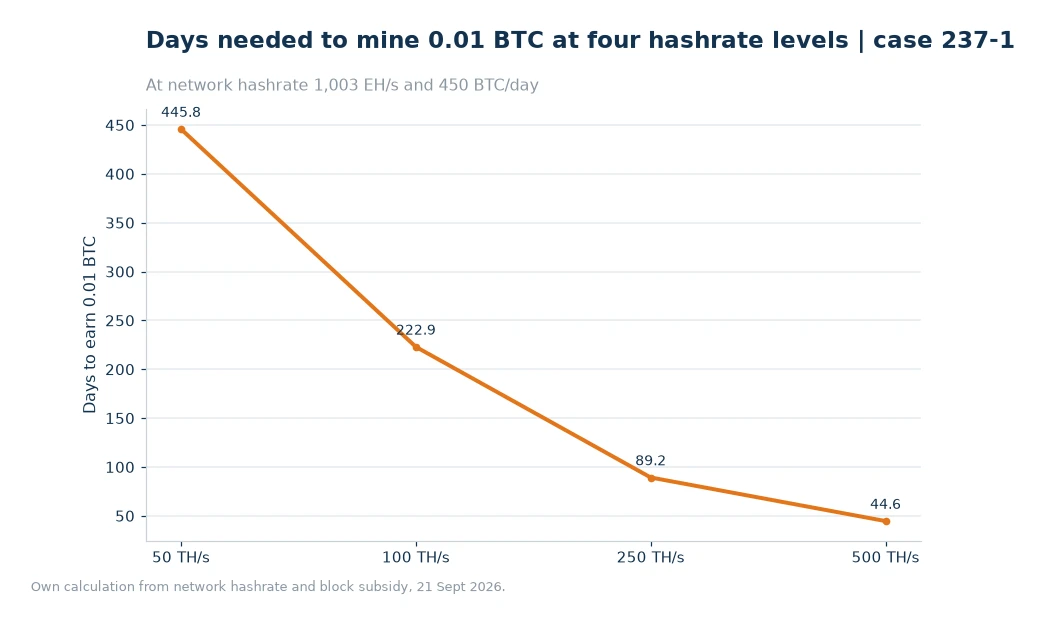
A 50 TH/s rig is not too small to mine; it is too small to hurry. At that hashrate, 0.01 BTC takes 445.8 days against a network total of 1,003 EH/s, while a 500 TH/s machine covers the same ground in 44.6. The number to decide with is not the coin, it is the calendar you are willing to accept.

Key takeaways
- At 50 TH/s, 0.01 BTC takes 445.8 days, or about 14.7 months of continuous operation.
- The same target at 500 TH/s takes 44.6 days, a tenfold difference that comes entirely from hashrate.
- Pool Hashrate is what turns your share into a time estimate, and it moves with every difficulty adjustment.
- Pool Luck changes the shape of the curve rather than its average slope, so a slow month is not evidence of a fault.
The target is a calendar, not a coin
A coin target sounds like a savings goal and behaves like a deadline. It converts every variable in the setup into time: hashrate decides how much of the target arrives each day, difficulty decides what a share is worth, and uptime decides how many days actually count. For a small rig, that conversion is the whole decision.
This is why a 50 TH/s machine can still be a rational purchase and a bad plan at the same time. The hardware works, the pool credits it, and the arithmetic is honest. What it cannot do is deliver 0.01 BTC inside a year, and anyone who bought it expecting a quarterly payout has bought the wrong size for the schedule they had in mind.
Why this becomes a fourteen-month job
Fifty terahashes is one twenty-thousandth of the network. Multiply that share by 450 BTC a day and the daily credit is 0.00002243 BTC, worth $1.90 at $84,692. Divide 0.01 by the daily credit and the answer is 445.8 days, which is 14.7 months at 30.4 days each. Nothing in that chain is pessimistic; it is just division.
The same arithmetic at 100 TH/s halves the wait to 222.9 days, and at 250 TH/s it falls to 89.2. Each step up is a step down in time, and the relationship is strictly proportional. That proportionality is useful because it means you can estimate any machine from the 50 TH/s baseline without rebuilding the whole sum.
Pool Hashrate is the only lever you control
The ViaBTC Pool Hashrate page sets out two totals that pull in opposite directions for a small miner. The pool total is where your shares are counted; the network total is what they are worth. You influence neither, but you can read both, and reading them is the difference between a plan and a hope.
What you control is the hashrate you point at the pool and the hours it runs. Neither is as fixed as it feels. A dirty heatsink can cost 5% of output without tripping an alarm, and a scheduled reboot every Tuesday can cost an hour a week, which is 2% of the year. At a fourteen-month horizon, small persistent losses compound into weeks.
That is the argument for measuring your own delivered hashrate rather than trusting the label. The pool reports what it receives. If the reported figure sits 8% below the spec sheet, the wait stretches by 8%, from 445.8 days to about 481. Finding that gap in month one is worth more than any optimisation in month twelve.
Pool Luck decides the shape, not the total
A pool finds blocks in clumps. Some weeks run ahead of expectation, some run behind, and the pool's published luck figure records which. For a miner paid under PPS+, the credit stays close to the arithmetic because it is settled against difficulty. For a miner on PPLNS, the same underlying luck arrives as visible variation in the balance.
The practical instruction is to judge a small rig over a quarter, not a weekend. A 50 TH/s unit earns $1.90 a day gross, so a single missed day is a noticeable percentage of a week and a rounding error over a year. Zoom out far enough and the clumps average into the slope you calculated; zoom in too close and every flat line looks like a failure.
The ladder from 50 to 500 TH/s
The table restates the same target in four time units, including a monthly figure that is easier to compare with a power bill.
| Hashrate | Days to 0.01 BTC | Months at 30.4 days | BTC per 30 days |
|---|---|---|---|
| 50 TH/s | 445.8 | 14.7 | 0.000673 |
| 100 TH/s | 222.9 | 7.3 | 0.001346 |
| 250 TH/s | 89.2 | 2.9 | 0.003365 |
| 500 TH/s | 44.6 | 1.5 | 0.006730 |
The monthly column is the one to hold against a bill. At 50 TH/s, 0.000673 BTC is about $57 a month at $84,692, and a rig drawing 1 kW at $0.06 per kWh costs roughly $44 a month before cooling. The margin is real but thin, and it is the reason a small miner should care about the tariff more than about the target.
What would make you switch it off
Three signals justify retiring a small rig: a power tariff that pushes the monthly cost above the monthly credit, a repair bill larger than the machine's remaining contribution, and a delivered hashrate that has fallen far enough to stretch the target beyond the horizon you accept. None of them is about the coin price alone, and all of them are measurable.
Write the three thresholds down before the next difficulty adjustment, while you are still calm about the numbers. A rule made in advance is easier to follow than a decision made on a bad week. The rig does not need to be defended or abandoned; it needs to be measured against a plan you set when the arithmetic was clear.
There is also a middle option between running and retiring. A small rig can be moved to a site with cheaper power, loaned to a friend with a spare circuit, or kept as a cold spare for a larger unit that fails. Each of those keeps the hardware useful without pretending that 50 TH/s is a fast route to a coin target.
Worked example
Start from the network total and walk down to a single 50 TH/s machine.
- Network output per day: 144 × 3.125 = 450 BTC.
- Per TH/s: 450 ÷ 1,003,000,000 = 0.00000044865 BTC.
- At 50 TH/s: 50 × 0.00000044865 = 0.00002243 BTC a day.
- Days to 0.01: 0.01 ÷ 0.00002243 = 445.8.
- Months: 445.8 ÷ 30.4 = 14.7.
- Monthly output: 0.00002243 × 30 = 0.000673 BTC, about $57 at $84,692.
- At 500 TH/s: 0.00022433 BTC a day, so 0.01 ÷ 0.00022433 = 44.6 days.
Frequently asked questions
How long does 0.01 BTC take at 50 TH/s?
445.8 days at 1,003 EH/s, about 14.7 months, because the daily credit is 0.00002243 BTC.
Does a small rig still make sense?
It can, if power is cheap and the wait is acceptable. At 50 TH/s the gross credit is about $1.90 a day, so the decision turns on the tariff and the machine's health rather than on the target.
Why did someone with the same hashrate reach 0.01 BTC sooner?
Either they mined when the network total was lower, or they are reading a PPLNS record that included a lucky block. Pool Luck changes timing, not the long-run division.
Decide what a month of waiting is worth
Convert the target into months, then convert the months into a power bill and a repair allowance. If the surplus survives a 10% rise in difficulty and a 10% rise in your tariff, the rig has earned another quarter. If it does not, the honest answer is that the machine is working and the plan is not.
The ViaBTC App keeps hashrate alerts in your pocket, which is useful for catching a silent drop, and the Statistics page shows the network total that sets your share. Neither makes the wait shorter. Both make it legible.
Sources: ViaBTC pool state, statistics and app pages; chain inputs read 21 Sept 2026: network hashrate 1,003 EH/s, difficulty 132.76 T, subsidy 3.125 BTC per block, 144 blocks a day, BTC $84,692. Monthly figures use 30 days. Figures read 21 Sept 2026, published 24 Oct 2026[1].